
Blogs
Solar Panels in 2026 vs 2016: What's Changed in the Last 10 Years?
Solar Information - Generating Energy
Solar Panels in 2026 vs 2016: What's Changed in the Last 10 Years?

Ten years ago, solar panels were seen as a luxury.
They were expensive, battery storage was virtually unheard of, and monitoring your energy usage from a smartphone felt like something from the future.
Fast forward to 2026, and the solar industry has changed dramatically.
Today's systems are more powerful, more intelligent, and offer far greater savings than those installed a decade ago. If you're considering solar panels, here's how things have changed and why many homeowners are making the switch now.
The Cost of Solar Has Fallen
One of the biggest barriers to solar adoption in 2016 was the upfront cost.
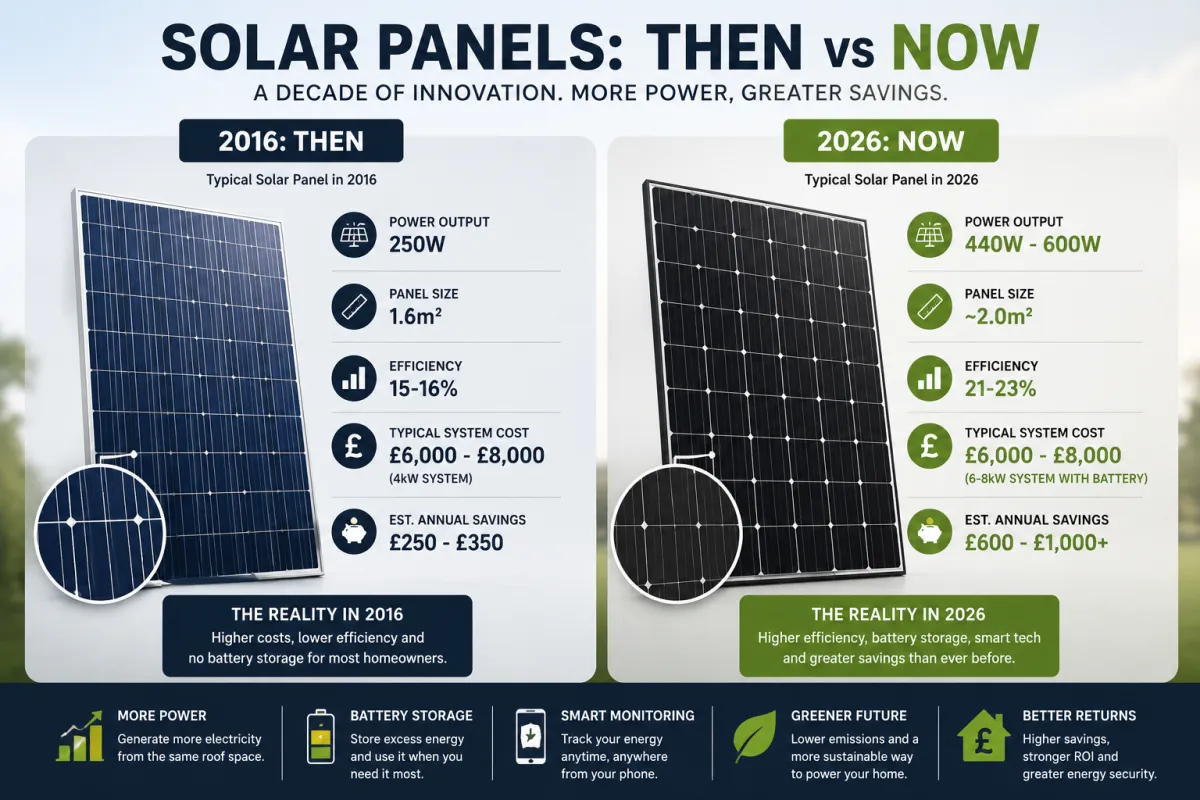
A typical 4kW solar system often cost between £6,000 and £8,000, with limited options for battery storage.
Today, homeowners can install larger, more efficient systems for a similar investment, despite inflation and rising material costs.
For the same budget that bought a basic solar system ten years ago, many homeowners can now install:
More solar panels
Battery storage
Smart monitoring
EV charging integration
The value for money has improved significantly.
Solar Panels Are More Efficient Than Ever
In 2016, most residential solar panels produced around 250W each. Today, it's common to see panels rated between 440W and 600W.
That means:
Fewer panels can generate more power.
Homes with limited roof space can produce more energy.
Larger systems can be installed without needing additional roof areas.
A roof that may have generated 4kW ten years ago could potentially generate 7kW to 10kW today using modern panel technology.
Battery Storage Has Changed Everything
Ten years ago, most solar owners had one option:
Generate electricity during the day and export any excess back to the grid. The problem?
Most homeowners were out at work when the solar was generating. As a result, a large percentage of their free electricity was simply exported.
Today, battery storage allows homeowners to:
Store excess solar energy.
Use it in the evening.
Reduce reliance on the grid.
Protect themselves against rising energy prices.
For many households, batteries have become just as important as the solar panels themselves.
Smart Energy Tariffs Didn't Exist
Back in 2016, most homeowners were on standard electricity tariffs. There were very few options to take advantage of off peak electricity rates or dynamic pricing.
Today, smart tariffs allow homeowners to:
Charge batteries overnight at cheaper rates.
Charge electric vehicles for a fraction of daytime costs.
Optimise energy usage automatically.
Combined with battery storage, these tariffs can dramatically improve overall savings.
Monitoring Your System Is Easier
A decade ago, solar monitoring often involved checking a small display in the loft or garage. Today, most systems can be monitored through a smartphone app.
Homeowners can see:
Live generation
Battery charge levels
Home consumption
Grid imports and exports
Historical performance
This gives users far greater control over their energy usage.
Electricity Prices Have Increased
Perhaps the biggest difference between 2016 and 2026 is the price of electricity. Ten years ago, electricity prices were relatively low and stable. Today, homeowners are far more aware of energy costs and are actively looking for ways to reduce their dependence on energy suppliers. Every unit of electricity generated by your solar system is one less unit you need to buy from the grid.
As electricity prices have increased, the value of self-generated energy has increased too. Electric Vehicles Have Increased Demand, In 2016, electric vehicles were still a niche product. Today, EV ownership is growing rapidly.
Many homeowners are now installing solar systems specifically to help offset the cost of charging their vehicles. A well designed solar and battery system can significantly reduce the running costs of an electric car.
The Return on Investment Is Stronger
Although government incentives such as the Feed-in Tariff have ended, modern solar systems often deliver stronger real-world savings because:
Panels are more efficient.
Batteries increase self-consumption.
Electricity prices are higher.
Smart tariffs create additional savings opportunities.
For many households, the financial case for solar is now stronger than ever.
Looking Forward
The way we use electricity is changing.
More homes are adopting:
Solar panels
Battery storage
Electric vehicles
Heat pumps
Smart energy tariffs
Modern solar systems are no longer just about generating electricity. They're becoming the centre of a smarter, more efficient home energy ecosystem.
Final Thoughts
If you looked at solar ten years ago and decided it wasn't for you, it may be worth taking another look. Today's systems are more powerful, more intelligent and offer far greater flexibility than ever before.
With rising electricity costs and advances in battery technology, there has never been a better time to take control of your energy and reduce your reliance on the grid.

Solar Panels in 2026 vs 2016: What's Changed in the Last 10 Years?
Solar Information - Generating Energy
Solar Panels in 2026 vs 2016: What's Changed in the Last 10 Years?
Ten years ago, solar panels were seen as a luxury.
They were expensive, battery storage was virtually unheard of, and monitoring your energy usage from a smartphone felt like something from the future.
Fast forward to 2026, and the solar industry has changed dramatically.
Today's systems are more powerful, more intelligent, and offer far greater savings than those installed a decade ago. If you're considering solar panels, here's how things have changed and why many homeowners are making the switch now.
The Cost of Solar Has Fallen
One of the biggest barriers to solar adoption in 2016 was the upfront cost.
A typical 4kW solar system often cost between £6,000 and £8,000, with limited options for battery storage.
Today, homeowners can install larger, more efficient systems for a similar investment, despite inflation and rising material costs.
For the same budget that bought a basic solar system ten years ago, many homeowners can now install:
More solar panels
Battery storage
Smart monitoring
EV charging integration
The value for money has improved significantly.
Solar Panels Are More Efficient Than Ever
In 2016, most residential solar panels produced around 250W each. Today, it's common to see panels rated between 440W and 600W.
That means:
Fewer panels can generate more power.
Homes with limited roof space can produce more energy.
Larger systems can be installed without needing additional roof areas.
A roof that may have generated 4kW ten years ago could potentially generate 7kW to 10kW today using modern panel technology.
Battery Storage Has Changed Everything
Ten years ago, most solar owners had one option:
Generate electricity during the day and export any excess back to the grid. The problem?
Most homeowners were out at work when the solar was generating. As a result, a large percentage of their free electricity was simply exported.
Today, battery storage allows homeowners to:
Store excess solar energy.
Use it in the evening.
Reduce reliance on the grid.
Protect themselves against rising energy prices.
For many households, batteries have become just as important as the solar panels themselves.
Smart Energy Tariffs Didn't Exist
Back in 2016, most homeowners were on standard electricity tariffs. There were very few options to take advantage of off peak electricity rates or dynamic pricing.
Today, smart tariffs allow homeowners to:
Charge batteries overnight at cheaper rates.
Charge electric vehicles for a fraction of daytime costs.
Optimise energy usage automatically.
Combined with battery storage, these tariffs can dramatically improve overall savings.
Monitoring Your System Is Easier
A decade ago, solar monitoring often involved checking a small display in the loft or garage. Today, most systems can be monitored through a smartphone app.
Homeowners can see:
Live generation
Battery charge levels
Home consumption
Grid imports and exports
Historical performance
This gives users far greater control over their energy usage.
Electricity Prices Have Increased
Perhaps the biggest difference between 2016 and 2026 is the price of electricity. Ten years ago, electricity prices were relatively low and stable. Today, homeowners are far more aware of energy costs and are actively looking for ways to reduce their dependence on energy suppliers. Every unit of electricity generated by your solar system is one less unit you need to buy from the grid.
As electricity prices have increased, the value of self-generated energy has increased too. Electric Vehicles Have Increased Demand, In 2016, electric vehicles were still a niche product. Today, EV ownership is growing rapidly.
Many homeowners are now installing solar systems specifically to help offset the cost of charging their vehicles. A well designed solar and battery system can significantly reduce the running costs of an electric car.
The Return on Investment Is Stronger
Although government incentives such as the Feed-in Tariff have ended, modern solar systems often deliver stronger real-world savings because:
Panels are more efficient.
Batteries increase self-consumption.
Electricity prices are higher.
Smart tariffs create additional savings opportunities.
For many households, the financial case for solar is now stronger than ever.
Looking Forward
The way we use electricity is changing.
More homes are adopting:
Solar panels
Battery storage
Electric vehicles
Heat pumps
Smart energy tariffs
Modern solar systems are no longer just about generating electricity. They're becoming the centre of a smarter, more efficient home energy ecosystem.
Final Thoughts
If you looked at solar ten years ago and decided it wasn't for you, it may be worth taking another look. Today's systems are more powerful, more intelligent and offer far greater flexibility than ever before.
With rising electricity costs and advances in battery technology, there has never been a better time to take control of your energy and reduce your reliance on the grid.

Contact Us
Generating Energy Ltd


© Copyright 2026. Generating Energy UK. All Rights Reserved.
Powered By: